Build architecture
Table of Contents
Introduction
Supply chain security is a priority for secureblue. During the the build process, we use complementary security mechanisms to protect against a variety of supply chain attack vectors. The documentation below covers each of these mechanisms, the protections they provide, and where secureblue uses these mechanisms.
Definitions
| Security mechanism | Implementation tooling | Attack vectors | Scope |
|---|---|---|---|
| Provenance | SLSA | <ul><li>Maintainer signing key theft</li><li>Rogue maintainers</li></ul> | • All secureblue OCI images • Trivalent RPM packages • BlueBuild build tools |
| Signatures | cosign, GPG | • Artifact tampering • Artifact forgery • Registry credential theft |
• All secureblue OCI images • All secureblue ISOs and torrents • All secureblue RPM packages • All Fedora RPM packages • All Flatpaks from Flathub (centrally signed) • BlueBuild build tools |
| Egress auditing | Harden-Runner | • Maintainer secrets exfiltration • Source code tampering • Dependency tampering • Registry credential theft |
• All secureblue OCI image builds • Trivalent RPM builds |
| Branch protection | GitHub Rulesets | • Maintainer source code repository credential theft • Rogue maintainers |
• All secureblue source code repositories |
Mitigation logic
Provenance
To generate provenance, the build platform (in our case, GitHub Actions) generates and signs an attestation file containing metadata about the build environment. Crucially, it cryptographically attests to the authenticity of runner and the source commit on which the artifact is being built. This attestation is then published in the repository or registry alongside the artifact.
On the client side, when the artifact is pulled, the signature of the attestation is validated against the build platform’s public key and the contents of the attestation are validated to confirm that the artifact was built: on an authorized runner from a commit in a specific branch in the source repository (in our case, protected by branch policies, pull request review, and maintainer login 2FA). This means that even in the event that a maintainer’s artifact signing keys and artifact repository credentials were both stolen, any malicious builds pushed by the credential thief would be rejected by clients due to provenance validation.
Signatures
A private key owned by the artifact maintainer is used in combination with a hash of the artifact to compute a signature. The signature is then provided alongside the artifact so that clients can verify the artifact signature before installing or using the artifact. For example, for our ISOs, each signature is shipped in a corresponding -CHECKSUM file.
Once the client has all of the required information, it can use the maintainer’s public key to verify the signature, revealing a hash that it then compares against a locally-generated hash of the artifact. This means that in the event that an artifact registry was compromised or artifacts otherwise tampered with by malicious third parties, any corresponding signature file would either not be present or fail validation.
Egress auditing
StepSecurity Harden-Runner provides network traffic controls and source code integrity monitoring, among other mechanisms. It restricts outbound traffic to a configurable list of authorized outbound domains, and enforces this at multiple levels (DNS, HTTPS, network layer, transport layer). It has several other functions as well, like monitoring the source code as the build progresses to ensure tampering doesn’t occur, monitoring for anomalous privileged processes, etc.
Branch protection
Branch protection via rulesets prevents any changes being made to secureblue source code without those changes first meeting specific criteria. Among those criteria is a minimum number of code reviews from maintainers, excluding of course the author of the pull request should they be a maintainer. This means that in the event that a maintainer’s source code repository credentials were stolen, the thief would be unable to push changes to the repository. This includes the repo owner credentials, since bypassing rulesets is only possible after 2FA has been granted.
Build process
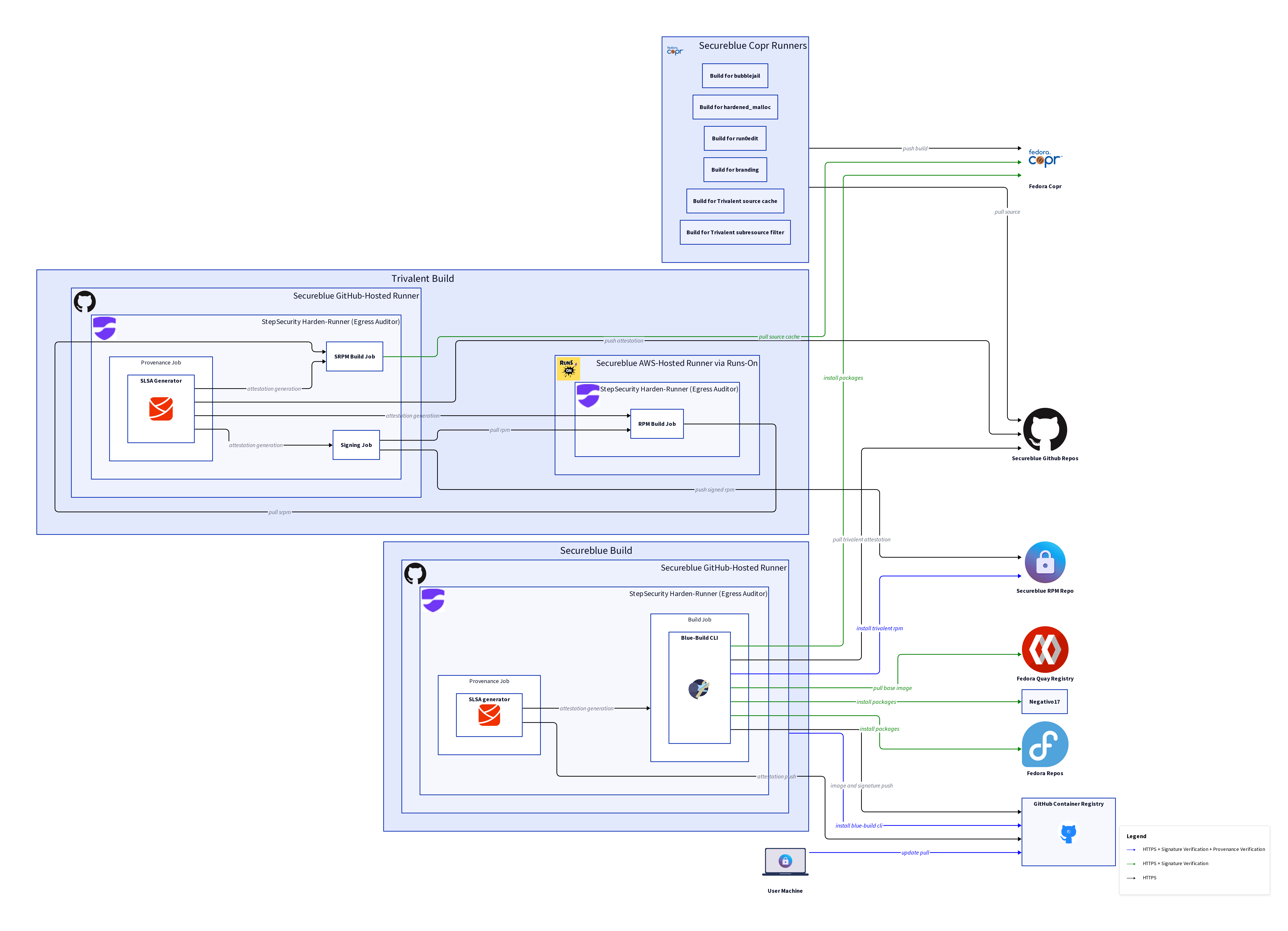
Trivalent Build
SRPM Build Job
- Run on a GitHub-hosted runner
- Run with StepSecurity Harden-Runner provisioned
- Install the Trivalent source cache package from secureblue’s COPR repos
- Validate the package’s GPG signature
- Push built SRPM to GitHub Artifacts
RPM Build Job
- Run on a GitHub-hosted runner
- Run on a secureblue-owned, AWS-hosted runner via Runs-On
- Run with StepSecurity Harden-Runner provisioned
- Pull SRPM from GitHub Artifacts
- Push built RPM to GitHub Artifacts
Signing Job
- Run with StepSecurity Harden-Runner provisioned
- Pull RPM from GitHub Artifacts
- Sign and push the RPM to secureblue’s RPM repo
Provenance Job
- Run on a GitHub-hosted runner
- Run with StepSecurity Harden-Runner provisioned
- Fetch hash information from the Signing Job
- Fetch context information from the GitHub Control Plane
- Generate, sign, and push the attestation to GitHub Artifacts
Secureblue Build
Build Job
- Run on a GitHub-hosted runner
- Run with StepSecurity Harden-Runner provisioned
- Pull base image from Fedora Quay
- Validate the image’s cosign signature
- Install packages from Fedora’s repos
- Validate each package’s GPG signature
- Install packages from secureblue’s COPR repos
- Validate each package’s GPG signature
- From Negativo17, replace certain packages that Fedora strips of patent-encumbered codecs
- Validate each package’s GPG signature
- Pull the Trivalent provenance from the Trivalent repo
- From secureblue’s RPM repo, install Trivalent
- Validate the repo metadata signature
- Validate the package’s GPG signature
- Validate the package’s provenance
- Sign and push the completed image to GHCR
- Push the image’s signature to GHCR
Provenance Job
- Run on a GitHub-hosted runner
- Run with StepSecurity Harden-Runner provisioned
- Fetch digest information from the Build Job
- Fetch context information from the GitHub Control Plane
- Generate, sign, and push the attestation to GHCR
Image Updates
- Pull the new image to the client machine
- Validate the image signature
- Validate the image’s provenance
Build architecture
Table of Contents
Introduction
Supply chain security is a priority for secureblue. During the the build process, we use complementary security mechanisms to protect against a variety of supply chain attack vectors. The documentation below covers each of these mechanisms, the protections they provide, and where secureblue uses these mechanisms.
Definitions
| Security mechanism | Implementation tooling | Attack vectors | Scope |
|---|---|---|---|
| Provenance | SLSA |
|
• All secureblue OCI images • Trivalent RPM packages • BlueBuild build tools |
| Signatures | cosign, GPG | • Artifact tampering • Artifact forgery • Registry credential theft |
• All secureblue OCI images • All secureblue ISOs and torrents • All secureblue RPM packages • All Fedora RPM packages • All Flatpaks from Flathub (centrally signed) • BlueBuild build tools |
| Egress auditing | Harden-Runner | • Maintainer secrets exfiltration • Source code tampering • Dependency tampering • Registry credential theft |
• All secureblue OCI image builds • Trivalent RPM builds |
| Branch protection | GitHub Rulesets | • Maintainer source code repository credential theft • Rogue maintainers |
• All secureblue source code repositories |
Mitigation logic
Provenance
To generate provenance, the build platform (in our case, GitHub Actions) generates and signs an attestation file containing metadata about the build environment. Crucially, it cryptographically attests to the authenticity of runner and the source commit on which the artifact is being built. This attestation is then published in the repository or registry alongside the artifact.
On the client side, when the artifact is pulled, the signature of the attestation is validated against the build platform’s public key and the contents of the attestation are validated to confirm that the artifact was built: on an authorized runner from a commit in a specific branch in the source repository (in our case, protected by branch policies, pull request review, and maintainer login 2FA). This means that even in the event that a maintainer’s artifact signing keys and artifact repository credentials were both stolen, any malicious builds pushed by the credential thief would be rejected by clients due to provenance validation.
Signatures
A private key owned by the artifact maintainer is used in combination with a hash of the artifact to compute a signature. The signature is then provided alongside the artifact so that clients can verify the artifact signature before installing or using the artifact. For example, for our ISOs, each signature is shipped in a corresponding -CHECKSUM file.
Once the client has all of the required information, it can use the maintainer’s public key to verify the signature, revealing a hash that it then compares against a locally-generated hash of the artifact. This means that in the event that an artifact registry was compromised or artifacts otherwise tampered with by malicious third parties, any corresponding signature file would either not be present or fail validation.
Egress auditing
StepSecurity Harden-Runner provides network traffic controls and source code integrity monitoring, among other mechanisms. It restricts outbound traffic to a configurable list of authorized outbound domains, and enforces this at multiple levels (DNS, HTTPS, network layer, transport layer). It has several other functions as well, like monitoring the source code as the build progresses to ensure tampering doesn’t occur, monitoring for anomalous privileged processes, etc.
Branch protection
Branch protection via rulesets prevents any changes being made to secureblue source code without those changes first meeting specific criteria. Among those criteria is a minimum number of code reviews from maintainers, excluding of course the author of the pull request should they be a maintainer. This means that in the event that a maintainer’s source code repository credentials were stolen, the thief would be unable to push changes to the repository. This includes the repo owner credentials, since bypassing rulesets is only possible after 2FA has been granted.
Build process
Trivalent Build
SRPM Build Job
- Run on a GitHub-hosted runner
- Run with StepSecurity Harden-Runner provisioned
- Install the Trivalent source cache package from secureblue’s COPR repos
- Validate the package’s GPG signature
- Push built SRPM to GitHub Artifacts
RPM Build Job
- Run on a GitHub-hosted runner
- Run on a secureblue-owned, AWS-hosted runner via Runs-On
- Run with StepSecurity Harden-Runner provisioned
- Pull SRPM from GitHub Artifacts
- Push built RPM to GitHub Artifacts
Signing Job
- Run with StepSecurity Harden-Runner provisioned
- Pull RPM from GitHub Artifacts
- Sign and push the RPM to secureblue’s RPM repo
Provenance Job
- Run on a GitHub-hosted runner
- Run with StepSecurity Harden-Runner provisioned
- Fetch hash information from the Signing Job
- Fetch context information from the GitHub Control Plane
- Generate, sign, and push the attestation to GitHub Artifacts
Secureblue Build
Build Job
- Run on a GitHub-hosted runner
- Run with StepSecurity Harden-Runner provisioned
- Pull base image from Fedora Quay
- Validate the image’s cosign signature
- Install packages from Fedora’s repos
- Validate each package’s GPG signature
- Install packages from secureblue’s COPR repos
- Validate each package’s GPG signature
- From Negativo17, replace certain packages that Fedora strips of patent-encumbered codecs
- Validate each package’s GPG signature
- Pull the Trivalent provenance from the Trivalent repo
- From secureblue’s RPM repo, install Trivalent
- Validate the repo metadata signature
- Validate the package’s GPG signature
- Validate the package’s provenance
- Sign and push the completed image to GHCR
- Push the image’s signature to GHCR
Provenance Job
- Run on a GitHub-hosted runner
- Run with StepSecurity Harden-Runner provisioned
- Fetch digest information from the Build Job
- Fetch context information from the GitHub Control Plane
- Generate, sign, and push the attestation to GHCR
Image Updates
- Pull the new image to the client machine
- Validate the image signature
- Validate the image’s provenance
Build architecture
Table of Contents
Introduction
Supply chain security is a priority for secureblue. During the the build process, we use complementary security mechanisms to protect against a variety of supply chain attack vectors. The documentation below covers each of these mechanisms, the protections they provide, and where secureblue uses these mechanisms.
Definitions
| Security mechanism | Implementation tooling | Attack vectors | Scope |
|---|---|---|---|
| Provenance | SLSA | <ul> |
• All secureblue OCI images • Trivalent RPM packages • BlueBuild build tools |
| Signatures | cosign, GPG | • Artifact tampering • Artifact forgery • Registry credential theft |
• All secureblue OCI images • All secureblue ISOs and torrents • All secureblue RPM packages • All Fedora RPM packages • All Flatpaks from Flathub (centrally signed) • BlueBuild build tools |
| Egress auditing | Harden-Runner | • Maintainer secrets exfiltration • Source code tampering • Dependency tampering • Registry credential theft |
• All secureblue OCI image builds • Trivalent RPM builds |
| Branch protection | GitHub Rulesets | • Maintainer source code repository credential theft • Rogue maintainers |
• All secureblue source code repositories |
Mitigation logic
Provenance
To generate provenance, the build platform (in our case, GitHub Actions) generates and signs an attestation file containing metadata about the build environment. Crucially, it cryptographically attests to the authenticity of runner and the source commit on which the artifact is being built. This attestation is then published in the repository or registry alongside the artifact.
On the client side, when the artifact is pulled, the signature of the attestation is validated against the build platform’s public key and the contents of the attestation are validated to confirm that the artifact was built: on an authorized runner from a commit in a specific branch in the source repository (in our case, protected by branch policies, pull request review, and maintainer login 2FA). This means that even in the event that a maintainer’s artifact signing keys and artifact repository credentials were both stolen, any malicious builds pushed by the credential thief would be rejected by clients due to provenance validation.
Signatures
A private key owned by the artifact maintainer is used in combination with a hash of the artifact to compute a signature. The signature is then provided alongside the artifact so that clients can verify the artifact signature before installing or using the artifact. For example, for our ISOs, each signature is shipped in a corresponding -CHECKSUM file.
Once the client has all of the required information, it can use the maintainer’s public key to verify the signature, revealing a hash that it then compares against a locally-generated hash of the artifact. This means that in the event that an artifact registry was compromised or artifacts otherwise tampered with by malicious third parties, any corresponding signature file would either not be present or fail validation.
Egress auditing
StepSecurity Harden-Runner provides network traffic controls and source code integrity monitoring, among other mechanisms. It restricts outbound traffic to a configurable list of authorized outbound domains, and enforces this at multiple levels (DNS, HTTPS, network layer, transport layer). It has several other functions as well, like monitoring the source code as the build progresses to ensure tampering doesn’t occur, monitoring for anomalous privileged processes, etc.
Branch protection
Branch protection via rulesets prevents any changes being made to secureblue source code without those changes first meeting specific criteria. Among those criteria is a minimum number of code reviews from maintainers, excluding of course the author of the pull request should they be a maintainer. This means that in the event that a maintainer’s source code repository credentials were stolen, the thief would be unable to push changes to the repository. This includes the repo owner credentials, since bypassing rulesets is only possible after 2FA has been granted.
Build process
Trivalent Build
SRPM Build Job
- Run on a GitHub-hosted runner
- Run with StepSecurity Harden-Runner provisioned
- Install the Trivalent source cache package from secureblue’s COPR repos
- Validate the package’s GPG signature
- Push built SRPM to GitHub Artifacts
RPM Build Job
- Run on a GitHub-hosted runner
- Run on a secureblue-owned, AWS-hosted runner via Runs-On
- Run with StepSecurity Harden-Runner provisioned
- Pull SRPM from GitHub Artifacts
- Push built RPM to GitHub Artifacts
Signing Job
- Run with StepSecurity Harden-Runner provisioned
- Pull RPM from GitHub Artifacts
- Sign and push the RPM to secureblue’s RPM repo
Provenance Job
- Run on a GitHub-hosted runner
- Run with StepSecurity Harden-Runner provisioned
- Fetch hash information from the Signing Job
- Fetch context information from the GitHub Control Plane
- Generate, sign, and push the attestation to GitHub Artifacts
Secureblue Build
Build Job
- Run on a GitHub-hosted runner
- Run with StepSecurity Harden-Runner provisioned
- Pull base image from Fedora Quay
- Validate the image’s cosign signature
- Install packages from Fedora’s repos
- Validate each package’s GPG signature
- Install packages from secureblue’s COPR repos
- Validate each package’s GPG signature
- From Negativo17, replace certain packages that Fedora strips of patent-encumbered codecs
- Validate each package’s GPG signature
- Pull the Trivalent provenance from the Trivalent repo
- From secureblue’s RPM repo, install Trivalent
- Validate the repo metadata signature
- Validate the package’s GPG signature
- Validate the package’s provenance
- Sign and push the completed image to GHCR
- Push the image’s signature to GHCR
Provenance Job
- Run on a GitHub-hosted runner
- Run with StepSecurity Harden-Runner provisioned
- Fetch digest information from the Build Job
- Fetch context information from the GitHub Control Plane
- Generate, sign, and push the attestation to GHCR
Image Updates
- Pull the new image to the client machine
- Validate the image signature
- Validate the image’s provenance